
Buzzard on road past Coralhill Farm, 9/10
To get to the plantation, a mile or more's walk is usually required from the village of St Combs' through many rough fields, but on taking the track down which I photographed the Buzzard, we cut off about half that walk, if not more. As soon as we parked up and got out the car, I was immediately on to two Robins, which was a good sign as we hadn't even reached the plantation yet, and they were most certainly migrants. Shortly after we started the walk down, I heard an odd call that I vaguely recognised, scanned the immediate field I was in, and saw two small passerines dip into some low lying dead vegetation not far in front of me. I proceeded to scan the area in search of them, and I couldn't quite believe my eyes! No sooner had I started checking the vegetation did I see a whole flock of Lapland Buntings feeding together! They kept themselves pretty well hidden, but to my astonishment, after close inspection I was able to count 19 Lapland Buntings in all! And to think that only a couple of weeks ago I had never seen Lapland Bunting before, when I was now watching 19 of them only 25ft or so away from me! I started to get the camera equipment out, and did so efficiently, but it was very difficult to get photos due to the vegetation not allowing for great views. I tried to get a bit closer to maximise my chances, but as I did so I inevitably sent the whole flock up. It was a magnificent sight to see these lovely little passerines take to the air together, calling as they flew and wheeling round several times. Eventually they disappeared from view. Magical stuff!
On approaching the plantation, there was the immediate impression of a fall. Scanning a single bush quickly produced a single Blackcap and 2 Robins, and in the trees above Song Thrushes and Blackbirds were regularly bombing it from one tree to the next. We decided we'd check the fringes of the plantation before going further in, and in doing so it also become apparent that Goldcrests were present en masse when we alighted on a whole group of them, and with the presence of lots of Goldcrests, there was a good chance of a Yellow-browed Warbler amongst them, especially when two had been seen in the plantation the previous day. Everywhere you looked, there were migrants, and our bins were pretty much consistently up trying to check them as they flitted between tree tops. Almost the entire group of the smaller passerines that we were on were Goldcrests, with maybe 12 or so of them there alone but for a milli-second my Dad thought he saw the back of what could be a Yellow-browed Warbler disappearing from view as the whole Goldcrest group moved away from the fringes of the plantation and went slightly further in.
Seeing that my Dad had possibly had a Yellow-browed Warbler already, it seemed quite a wise idea to depart from him and venture into the plantation slightly at the nearest oppurtunity as the Goldcrest flock hadn't gone far. Fairly quickly, I left him to check the fringes and headed into the plantation itself. I soon was around the Goldcrest flock, which I wasn't seeing particularly well but was hearing above me - a cacophony of high-pitched monotone calls. I craned my neck as I got onto several of them up high in the trees, but there were no other smaller passerines amongst the higher birds, and craning the neck got painful after a while. Other Goldcrests and several Song Thrushes were keeping to the vegetation lower down, but no sign of anything other than this until I got onto the back of a plump, greeny coloured passerine; a warbler. I waited for it to turn round, and to my absolute delight I was presented with a Phyllosc with a whacking great yellow supercilium, 100% a Yellow-browed Warbler! I relished the two second view I got of this beautiful bird as it sat itself on a tree stump, before it flew and moved further into the plantation. This was fantastic, and confirmed that the possible back of YBW my Dad had had minutes earlier was indeed what he thought it was. An absolute cracker, and only my third ever sighting of this lovely species!
After a couple of more minutes of scanning the immediate area that I was in, I decided I'd catch up with Dad and give him the news. I did so, and he was happy to hear that I had seen it and confirmed the sighting previous to that. He hadn't had much on the fringes apart from more Goldcrests, so we both headed a lot further into the plantation We spent over a couple of hours in the plantation, as there was so much to do, and we managed to get some very nice totals of commoner thrushes, warblers and such like (see below). About half way through our check was one of the most productive periods, with one little area producing 5 Chiffchaffs, 2 Blackcaps, a migrant Treecreeper and a split second views of a cracking female Redstart. Shortly afterwards there was a bit more quality again, when, to my frustration, my Dad got very brief views of a Yellow-browed Warbler amongst a couple of Chiffchaffs, which I missed by mere seconds. Whether this was the same bird that I had seen earlier or a different one it is hard to tell, so I would put it down to one or two Yellow-browed Warblers that we saw. At several points Yellow-browed Warbler was heard as well - a disyllabic, drawn out, high-pitched and surprisingly loud 'tseeweeeet', very distinctive and easily told from the monosyllabic, lower-pitched call of the Chiffchaff - so it may well have been that there was 2. Not very long afterwards, at a point where my Dad and I were both together, we were alerted by the call of Lapland Bunting yet again, this time from above the plantation. I was astonished when I had seen the 19 together, but when I looked up this time I was even more gob-smacked. A total of 31 Lapland Buntings were flying over the plantation, wheeling round and calling regularly a few times before eventually going out of view! I was completely taken aback by this, as this was a massive total and something I wasn't expecting by any means! I am pretty sure that the group would have included the same 19 I had seen earlier, but there is the outside possibility it was a second, seperate flock.... It is hard to tell! Really, even though the abundance of commoner migrants was exciting in itself, it was the Yellow-browed Warbler and the Lapland Bunting numbers that were the highlights of the check for me. It was just astonishing to see so many of the latter together, it really was! We met one of the wardens whilst in there, and told him of our totals. So, a fantastic trip to the plantation that was absolutely teeming with birds. Here are the mig totals in the plantation:
75+ Goldcrests, 50+ Robins, 31 Lapland Buntings, 25+ Song Thrush, 20+ Blackbirds, 7+ Chiffchaff, 5+ Blackcap, 5+ Redwing, 2 Willow Warbler, 1 Redstart, 1 Treecreeper 1 Fieldfare, at least one (possibly two) Yellow-browed Warblers.
On the way back to the car at around 2:30pm a text came through of a possible Blyth's Reed Warbler at Rattray Head, just a few miles south of Strathbeg. In getting that report, we headed straight down there to find a good number of birders with their eyes on a particular bush. It occured that most of the more important birders in Aberdeenshire (County Bird Recorder etc) were there, and they immediately told us 'Sorry to send you on a wild goose chase, but its a Reed'. Oh dear! I did see the Reed Warbler, only my second of this species for North-East Scotland (any Acro is notable here!). I must say I could see how it looked strange, it was noticeably paler than most Reeds I've seen and seemed to have a shorter primary projection tha your average Reed. I cannot, however, be bothered to go into the factors to why it was re-identified as Reed, that's slightly beyond me! Also in the bushes here there were many Robins and Goldcrests like at the plantation. Oh well, Reed Warbler was a nice bird for the day as it was. We then headed to check the pools at Strathbeg itself. Nothing much at all was going on here, with 19 Dunlins and 2 Greenshanks being the only things providing any sort of interest, plus several hundred Wigeons and Pink-footed Geese. The final stop of the day was at Cairnbulg Beach, just 5 or 6 miles north of Strathbeg. There had been a Little Stint a couple of days ago here, a bird I was yet to see for the year and was keen to catch up on. After about 10 minutes or so of looking, there it was amongst a group of 40 Dunlins, a cracking juvenile Little Stint. Fantastic views were obtained of it through the Swarovski, and it was a relief to see one for the year at last. This was a very nice end to what, retrospectively, was a very good day's birding. Unfortunately no other photos were taken, as the Little Stint was seen in poor and fading light, and the passerines at the plantation were just too mobile for photos!
The next time I post I will have spent 5 days on Fair Isle and two days twitching in Shetland. What I see is down to the luck of the draw, but one things for sure is that I am excited! Tune in next time for a trip report.
ATB,
Joseph

 Lapwing, Inches Point, Ythan Estuary (28/8)
 Mallards, nr Slains Pool, Ythan area (28/8)
 This Osprey flew high over our heads! (28/8)
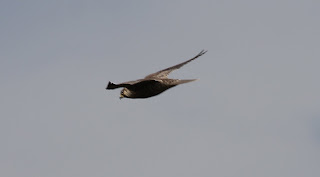 Peregrine, Loch of Strathbeg (28/8)
 Whitethroat, Loch of Strathbeg (28/8)

