'A Nice Day for Ducks' is a phrase usually used in association with wet weather. However, my usage of the phrase does not intend to have this connotation. I am using the phrase in the context of me actually managing to see some good duck species on my birding outing this Sunday just past (20th Feb). Hitherto this weekend I had been unable to get out all month due to two consecutive weeks worth of more or less non-stop rain, which admittedly was very frustrating. However, I did manage year-ticks in the city in the form of a Peregrine Falcon over the house (only my second over the house) and a Sparrowhawk. It was relieving to finally get out this weekend, and with some decent winter birds at my local patch of the Loch of Strathbeg such as Green-winged Teal and Hen Harrier, I knew that that was the best place to be.
However, before getting to Strathbeg I wanted to stop off at a couple of places. Firstly, I wanted to check Johnstone Gardens in Aberdeen for a drake Mandarin Duck that had been seen there a couple of weeks earlier. Like with all Mandarins, I knew its origins would be debateable, but I was keen to check it out and see if I could shed any light on its origins. I arrived there at 9:30, and what with it being a small area, had the whole area covered within 10 minutes. Unfortunately it didn't seem to be present with the Mallards and Moorhens in the area, and thus I never saw it. Maybe the fact that it had disappeared is indicitave of it being a wild bird... I will never know, but such behaviour certainly suggests it to me! My next stop was at my other local patch of the Ythan Estuary. A check of the main part of the estuary revealed that several waders were wintering in the area, with a rather impressive 110 Knots (yeartick) mixed in with an equally impressive 130 Dunlins, 40 Golden Plovers, and several Lapwings, Curlews and Redshanks. Apart from the noticeable variety and totals of commoner waders, there was very little else on the Estuary. On the nearby Meikle Loch, several Goldeneyes and Tufted Ducks were swimming about, as was a female Goosander, a new species for Meikle Loch. On the way to Strathbeg, we stopped several times to intensly check fields with gull flocks in them in the hope that there may be something more interesting amongst them -I was letting out the inner larophile within me! Unfortuantely, I was unsuccessful in finding anything more interesting than the usual variety.
We arrived at Strathbeg on the verge of midday, going into the visitor centre and having a nice chat with one of the local birders about what was around and other things avian. We were informed that there wasn't too much about from a nice assortment of commoner ducks, but I didn't let this discourage me from looking for the scarcer birds that I knew were lurking somewhere on the reserve - namely Green-winged Teal and Hen Harrier. As I checked the pools I noted a pair of Shoveler (yeartick) amongst the Wigeons and Teals in their hoards, as well as several pairs of absolutely stunning Pintails, the latter of which seemed to spend a lot of times with their rear ends sticking in the air and their heads submerged in the water. I checked as closely as I could for the Green-winged Teal, which was very tricky due a majority of the ducks being very distant, but failed to find it. However, as I came back across the Pintails I had seen earlier I noticed a much, much smaller duck appear from a dive beside them with a red head. I immediately declared 'I've got a redhead Smew', vaguely aware that one had been around for the winter but that it hadn't been seen in several days. I informed my Dad and the birder we were speaking to where it was, and they subsequently caught onto it and thanked me for re-finding it. If I was able to re-find this Smew without it being seen before, maybe there was more to find that was yet to be seen that day, I thought to myself...
I was right. Having birded for about half an hour from the Visitor Centre, I was taking a short break from scanning the pools when I noticed out the corner of my eye that a large, pale coloured bird was flying to the left of me. I turned round and, to my delight, locked onto the male Hen Harrier, one of my targets for the day. Yet again, I immediately alerted every one else of my sighting. Only very briefly was I truly mesmerized by its magnificence and beauty, as I saw it zoom southwards close to the side of the visitor centre building. Now, I find that you can never settle with just brief views of a male Hen Harrier, you have to get good, prolonged views! So my Dad and I quickly went out of the Visitor Centre to see if we could re-locate it. We checked the field in front of the car park feeders, and sure enough, there was the male Hen Harrier alongside a Buzzard. It was the epitome of elegance, sleeker and much thinner than the Buzzard beside it. The Buzzard soon flew out of sight, meaning we were left to watch the rather windstruck male Hen Harrier quartering the field. The wind forced it to go at some speed, but I was still able to become enchanted by this maginificent beast, what with its ghostly grey plumage and general flamboyance! I watched it for about a minute before it eventually flew westwards and out of sight. I thus went back to the Visitor Centre over the moon and rather spell-bound - male Hen Harriers are just beautiful! We had lunch in the Visitor Centre, during which I managed to see 2 Ruffs (1 down from my total of 3 on my previous visit) and continued to watch the redhead Smew. We then decided that we'd head to Tower Pool Hide to get closer to the ducks and have another stab at finding the Green-winged Teal. I was on a role, having already re-found two of the better birds in the area. I just needed to try and re-find this Green-winged Teal now.
On arrival at Tower Pool hide Dad used the scope and searched for the Green-winged Teal first. He wasn't able to find it on his first try, but we were both able to count a pretty surprising total of 28 Pintails, more than I have ever seen before! Once I had the scope, I proceeded to look as meticulously as I could for the Teal. About 10 minutes passed with no success whatsoever, when suddenly, as I was checking some of the closer ducks to us I alighted upon a group of Teals that contained an indivdual without a horizontal white stripe that looked somewhat bulkier than its fellow Teals. I waited for it turn round, and noticed a vertical stripe. "YES!', I thought to myself as I saw this bird; I had just found the drake Green-winged Teal after a few days of it not being seen, my third re-find of the day! I was elated, and quickly got another birder in the hide onto it and let my Dad see. What ensued was very good, prolonged views through the Swarovski of the drake Green-winged Teal down to about 120ft at its closest. Views of this bird were far, far better than the views I got of the drake in Kinneil Lagoon (Forth) back in December (I didn't just see it roosting and it wasn't at great distance)! It differed from the Kinneil bird somewhat, with a seemingly larger yellow vent than its commoner cousins, a slightly larger and bulkier appearance, and most importantly its vertical white stripe was indistinguishable in comparison to most Green-winged Teals - it was very thin and wasn't a very prominent white at all, but was still noticeable. If this bird had been at distance, it may well have been a trickier ID! It was brilliant to see this Teal, as not only was it a lovely bird but it was also a very useful year-tick that took me till the last few days of December to see last year, a species that I could have very easily missed this year, and only my third ever! We watched it for about half an hour, and then left, receiveing news from a couple of birders that they had seen two White-fronted Geese at the Ythan on Saturday. We ended up going back to the Ythan to search for these White-fronts, but were unsuccessful, despite finding and checking several Pinkfeet flocks. It really was a day for ducks, despite dipping on the Mandarin at Johnstone Gardens! Below are the duck totals for the day:
1 drake Green-winged Teal, 28 Pintails, 1 redhead Smew, 2 Shoveler, 2 Gadwall, several hundred Wigeons and Teals, 1 female Goosander
Overall, it was a fantastic and fulfilling day - I had managed to re-find three birds before anyone else at Strathbeg, I had seen both the targets that I had come to see (Hen Harrier and GW Teal) and saw some other lovely birds! Furthermore, the yearlist increased to 98 species. A very successful winter days birding! Excuse the absence of photos in this post, the light was poor and most birds were too far away to photograph. Don't worry though, there will be photos soon!
Thanks for reading,
Joseph
Tuesday, 22 February 2011

Saturday, 12 February 2011
NEWS: Fair Isle Trip Report (October 2010) Now Published!
FAIR ISLE TRIP REPORT NOW PUBLISHED!
This is my third 'page' that I have published, and that's right, it's of my Fair Isle Trip Report from October 2010, which I can only describe as so good that it took absolutely ages to write about! The trip report includes in-depth analysis on each day spent on Fair Isle and the birds seen on those days, plus my very own photos of the birds and the landscapes there.
To read the report please click the tab below my title photo that says 'Fair Isle Trip Report'. I would really appreciate any comments or feedback you may have on the content on the report and your thoughts on it. However, you aren't actually able to comment in the actual page itself, so.... ALL COMMENTS ON THE TRIP REPORT ARE TO BE POSTED HERE!!!
Thank you very much, I will look forward to your thoughts and I hope you enjoy the report!
Joseph Nichols
Tuesday, 1 February 2011
Birding In Perthshire and The Fife Coast
This weekend just past saw a drastic change to the usual way that I go about my birding. Most of the time I engage in hardcore local patching, but on Sunday (30th Jan) I did the opposite from this - I twitched. This was partly due to the fact that it was quiet in Aberdeenshire and I was hoping to get to 100 by the end of January, but mostly because I wanted to do something that I had always wanted to do - go to Scone Palace in the county of Perthshire to see if I could see a bogey bird of mine, the Hawfinch. Scone Palace is arguably the best place in Britain for Hawfinches, with fairly large numbers present there each winter. On birdguides last week the Hawfinches at Scone Palace were reported regularly, and what with Hawfinch being a bogey bird and a species that I had always wanted to see, I couldn't resist the temptation in organising a day down that way. Convieniently, there were some birds in the nearby county of Fife that I could also go for; namely Black Redstart at Crail and Mediterranean Gull at Buckhaven. With these extra birds being around not far away, I managed to convince my Dad to make a day of it.
We woke up very early that morning (around 6:15) and were on our way by 7:00, as we had several places to go to and going any later would mean we wouldn't have enough daylight to get everywhere we wanted to go. The drive down to the Perth & Kinross area was nice and smooth, and we were in the area by 8:20. Before moving on to Scone Palace to try for the Hawfinches we took a detour. This detour was taken so we could see some Waxwings reported just off the motorway (A90) at a roundabout near a little village called Longforgan. Shortly after we were off the motorway we arrived at the roundabout, and in some trees surrounding it sat a total of 90 Waxwings, trilling away and busily flitting from branch down to 40ft. I hadn't seen any Waxwings since early December, so it was fantastic to see them again and pick them up for the year at Longforgan. The sun was still rising as we arrived, so all my photos from my proper camera were very poor. The photo below was taken on my Kodak compact digital camera; pretty poor really, but good enough for a record shot of all the birds!

Waxwing, Longforgan, Perth & Kinross, 30/1/11
After a short while we headed off towards Scone Palace, and we were there by 9:00am. I had been told that the best place to see them was outside the palace grounds in the woodland (called Old Scone Wood) in and around the side entrance to the Palace. They had been reported the day before in and around an archway that was apparently at the end of the side entrance. With the necessary directions, it wasn' t too difficult to find the side entrance. We parked within the vicinity of it and proceeded to walk slowly down the side entrance and towards the archway, listening and looking out for Hawfinches. I could instantly see as I walked down the road that this was absolutely perfect habitat for Hawfinch - vast, mixed woodland comprising mostly of ancient fir and yew trees, all massively tall and ideal for the birds to spend time in. I was obviously aware that this was going to be a challenge, what with the elusiveness of this species and the sheer amount of woodland they could be hiding in. It was indeed a challenge. Over an hour was spent looking for them in and around the archway with no success whatsoever - I had to content myself with a variety of tit species, including Long-tailed. Interestingly there weren't any common finch species present in the wood, so if I was to come across any finches I came to the conclusion that they'd likely be the Hawfinches. After this hour had past, we were very close to giving up and my Dad suggested that we should move on. However, I decided I would check the area one more time before we went; this is where I got lucky. As I was checking one last time, I flushed up a small group of birds. As soon as they took flight I locked onto them in the bins, and I could immediately see that I had just found the Hawfinches. I quickly lost sight of them as they flew behind a tree, feeling relieved and delighted but desperately hoping that they'd fly by my Dad so he could catch onto them for 100% confirmation. Luckily he did, as very quickly after they disappeared from my view I heard him impetuously shouting my name. I quickly joined him, and he told me that he saw them head to the left of the archway and that he counted a total of 15, so we headed off to see if we could re-find them.
From this point onwards we continually refound them. Frustratingly, however, our views were poor and were almost entirely of the flock in flight - they certainly were proving very flighty and hard to observe! Despite the annoyingly brief views though, they completely stood out when we did see them: the very big and conical shaped bill, large head and thick neck, the short tail and the diagnostic broad, white bands on the underwing all very prominent on each individual. Rarely have I seen a species of passerine with such distinctive proportions. They even called as they went; a hard and sharp clicking 'pix!' that was somewhat reminiscent of the first note of a Robin's call ('tic'). We had at least 6 views of the 15 Hawfinches in flight before I finally managed to get views of them actually sitting somewhere. The lead up to this moment is going to stay with me for a long time to come. My Dad and I had managed to flush the flock further into the wood, and after a short while managed to hear them. We traced the sound into a clearing in the wood, and started walking around this clearing, keeping our eyes peeled for them. I was given a pretty big shock when, whilst I was looking, the Hawfinches very suddenly exploded out of the nearest tree to me at great speed. There was much more than 15 this time as wll! I had no idea that they were there, but I was left mesmerised for a few seconds after this experience - a once in a lifetime moment, I feel! The flock, which had now increased in number, landed on a lowish tree for about 5 seconds, at which stage I managed my only views of the birds not in flight and counted a total of 30+ Hawfinches, which I thought was an astonishing number! No sooner had the birds touched down again and they were in flight, this time zooming off away from the clearing and well out of view. That was that. I left Scone Palace a very happy man, delighted to have finally come across this bogey species, seen my first lifer of the year, and most of all to have found such a large number of them after all that effort!
It was then away from Perthshire and onto the Fife Coast, where we would spend the rest of the day. Our first stop here was the town of Kirkcaldy for an Iceland Gull that had been reported at the Esplanade there. Precise directions meant that we found the location fairly easily, and we arrived just after 11:00 to find a group of gulls sitting on the sea very close offshore. It became apparent very quickly that there was no Iceland Gull amongst these gulls. We scanned the whole area of sea for any other gulls and were able to find several groups, but it didn't seem to be amongst them either. We did manage a Rock Pipit (yeartick) here, though. Despite dipping here, I was determined that the rest of the day would be successful, so we headed up the coast to our next destination; Buckhaven, famed amongst Scots birders for holding a few resident Mediterranean Gulls. Buckhaven was only 15 minutes away, and having been before in 2010 (I managed to dip last time), I knew where to go - Shore Road, a small road with some modern housing looking out onto the Firth of Forth. On arrival at Shore Road I immediately took to scanning the grass for one, and low and behold, in the second group of Black-headed Gulls I checked there was one Mediterranean Gull - a Scottish tick for me and only my 4th ever sighting of one! My Dad parked up, and I proceeded to get out the car to try and photograph it. As I did so, it flew up onto a lampost, allowing me to get some shots of it. Below are the best shots I managed of it (light wasn't good at all though) - note the thick, prominent red bill and the all-white plumage of the bird. Interestingly, you'll also see that this bird is ringed. I wasn't able to get a picture showing the details on the ring, but I am currently enquiring as to the location that the ringing took place in. Will be interested to find out more...

Mediterranean Gull, Buckhaven, Fife, 30/1/11


 This fantastic creature flew from its perch on the lampost after about 5 minutes and proceeded to land on the sea very close offshore. As I tracked, I set eyes on yet another Mediterranean Gull, meaning there were now two Med Gulls. The second individual was not as far developed in terms of phasing back into breeding plumage as the first, but was still a fantastic bird. What ensued was fantastic views of these two Med Gulls bobbing gently up and down on the sea for about 20 minutes. They were the closest birds to me, no more than 25ft offshore. Here are some photos I managed of both of them.
Mediterranean Gulls, Buckhaven, Fife, 30/1/11


After taking photos of these beautiful gulls I checked the Firth of Forth for any seaducks, grebes or divers that may be around. This was worth it, as it provided plenty of seaducks in the form of over 80 Velvet Scoters (yeartick), 40 Common Scoters (yeartick), and 15 Long-tailed Ducks. Having seen the Med Gulls so well and having also coming across the nice variety of seaducks, I left Buckhaven feeling rather good. I was soon to be disappointed again though, when a check of Lower Largo in Largo Bay for the drake Surf Scoter that had been seen there proved unsuccessful. I was hoping for grebes and divers here as well, but there was very little apart from a raft of Velvet Scoters. It was around 2:00pm, and there was only one more place left on the itinerary for us to go to - Crail for the Black Redstart.
Crail is about 30-35 minutes away from Lower Largo and is one of the northernmost places on the Fife Coast. The Black Redstart here had been seen in a bay called Roome Bay. There was no problem finding this, and on arrival I headed down to the cliffy area of beach in which it had been seen. A photographer and several birders were already down on the beach, so it was clearly still present. Once down there I quickly caught sight of the Black Redstart; a truly stunning male, with the diagnostic greyish black plumage, red tail and bold white wing patch. It was a very mobile bird, clearly nervous of everyone around it as it constantly vibrated its brilliant red tail. It regularly flitted from rock, perching upright every now and then before flying again. This made it pretty difficult to photograph, and what with the light conditions my results weren't good. It was a magnificent bird and a very valuable year tick though! Other year ticks in the area included a fine Grey Wagtail and a Meadow Pipit. Below are the two best photos I managed of the Black Redstart + a picture of Roome Bay.

Black Redstart, Crail, Fife, 30/1/11

 It was around 15:45 when we left Crail, and with nowhere else to go we decided to call it a day. Despite two dips and the yearlist only increasing 9 species from 81 to 90, it was a very successful day - you wouldn't say no to 30 Hawfinches, 2 Med Gulls, 90 Waxwings and a male Black Redstart, would you? Winter birding at its best, and a fantastic way to end January!
Thanks for reading,
Joseph
Sunday, 23 January 2011
Northwards...Southwards....
That's right, I spent both days this weekend (22nd-23rd Jan) birding! Prior to yesterday, I hadn't been out for a full day's birding in 2011, meaning that the yearlist remained low. This weekend I was keen to increase on my total of 54, with many very easy birds still to be seen. I spent yesterday north of Aberdeen, firstly at Donmouth to see what I could pick up for the year. A short walk along the beach here produced at least 30 Teal, a drake Goosander, a group of 8 Sanderlings scuttling hither and thither along the shoreline and a Red-throated Diver hurtling its way northwards. All of these were yearticks - a nice little variety of birds to kick off the day. It was then onwards and upwards to my local patch of the Ythan Estuary. I had contemplated checking the dunes at the mouth of the estuary for Twite and Snow Bunting, but decided that I'd rather check the actual estuary itself. Here I was entertained by an assortment of nice birds, mostly notably of which was 2 drake Long-tailed Ducks swimming together quite close to the car at Inches Point. I was also astonished by the number of Bar-tailed Godwit at Inches Point, with 23 counted here alone, quite something considering the time of year. Other year ticks here included a nice female Red-breasted Merganser and a Little Grebe. We proceeded to move further up the estuary, surprisingly picking up a group of 4 Grey Partridges in a field by the road on the way. From our usual stopping place at the second car park north of Newburgh, yet more new birds were seen - a flock of 70 Golden Plover, 80 Dunlin, Lapwing, Greylag Goose and Canada Goose. The latter two species were hanging around together, and interestingly included a Canada Goose x Barnacle Goose hybird bird.
The rest of the day was spent at the Loch of Strathbeg, which in all fairness was quiet. Tree Sparrow was quickly seen in the visitor centre car park, and I counted a total of 80. Now, Tree Sparrow is a very easy bird to get at Strathbeg, but 80 is a pretty exceptional number - perhaps the hard weather from a couple of weeks ago has made them congregate in such numbers. There wasn't much at all to be seen from the visitor centre, but Coot, Gadwall, 3 Barnacle Geese amongst the Pinkfeets, and Whooper Swan were added, the total number of the latter species at 31. The highlight here though goes to a species that you'd never expect to see at this time of year and is an exceptionally early record for this species. 3 Ruffs were on the reserve, and shortly after we arrived I sighted them on the back pools towards Tower Pool Hide. Normally it takes me until April or May to pick up my first Ruff of the year, so this was a pleasant surprise and is noteworthy on the basis of just how unseasonal this sighting was. A trip round to Tower Pool Hide produced very little apart from better views of what had already been seen from the Visitor Centre, so we spent the last part of the day at Fen Hide on the other side of the reserve in the vague hope that the male and ringtailed Hen Harriers reported to have been seen on the reserve would reveal themselves majestically above the reedbeds. 'Dream on', I thought as the sun started to set and I watched the Pink-footed Geese, Goldeneye and other wildfowl go about their buisness. It was a pretty quiet day, but I still managed those Ruffs, constituting to one of 21 year-ticks over the day. This took me up to 78 species.
Today was a different sort of day - devoid of many new birds for the year, but those new birds that I did get were of good quality. I started the day with a quick check of Girdleness, which was very quiet. The only real thing of note here was a Great-crested Grebe in Nigg Bay (yeartick). I then decided to try my chances at the Red Moss of Netherley, an area a few miles SW of Aberdeen which has held a Great Grey Shrike fairly recently. The GG Shrike hadn't been reported for two weeks, but I was still keen to look for it as I suspected that it could still be there and that the reason it hadn't been reported was because no-one had checked. I had the directions to the place all sorted out to where it had last been seen - I knew that it was 50/50 whether I was going to see it or not. It was about 11:00am, and we were getting very close. We were within sight of the Moss, and I was keeping my eyes peeled just in case I was to see anything. All of a sudden, I turned to get a split-second view of a small, miniature magpie like bird with a long tail perched on top of a tree right at the side of the road. Impetuously I shouted, 'STOP THE CAR, I THINK I JUST SAW IT!'. Dad, having gone at least 50mph, made the car come to a grinding halt, and just to our luck there was a little layby at this point so we convieniently stopped here. I got out the car, binoculars already in hand, and rushed back to the tree in which I had seen this bird that I suspected to be the Great Grey Shrike. It was still there. I raised the bins, and to my delight I had indeed just re-found the Great Grey Shrike, after two weeks of no-one reporting it!
***
A feeling of pride and joy surged through me - if I hadn't had made that split-second spot, I would have driven past the bird and likely have never seen it. Dad shortly joined me and saw the bird, but not long after he arrived it flew down from the tree and went into the reserve. We managed to climb over the short fence, and luckily quickly relocated the shrike on a row of fenceposts surrounding an area of sapling trees. Other fences meant that we couldn't get very close, so we set up the Swarovski and were treated to fabulous views of the Great Grey Shrike as it sat there, vigilantly and intently staring at the ground, waiting patiently for any insects that strayed across its path. Occasionally it would dive onto the ground, presumably due to spotting an insect, and then return to its perch. After 10 minutes of good views through the scope, it flew from the fenceposts onto its new vantage point - one of the saplings, looking very long-tailed and flying in a somewhat undulating fashion. At this point I got the camera out and attempted to get some record shots, trying to get as close as I could to it. I managed to get a few photos here, but my presence made it nervous and resulted in it moving to various different sapling trees, until it eventually moved onto a telephone wire. Dad joined me, and we watched it for a while until it then flew away from the Moss and onto some bushes on the other side of the road, conveniently nearby. This was the best opportunity to get some photos, so I proceeded to go up the lane and see if I could get some better ones. At first, I kept flushing it further and further up the lane - mobile and flighty are the perfect words to describe this bird! However, I eventually managed to get within about 50ft of it and get some OK photos. The light was pretty poor, so the photos aren't of great quality. I spent a short amount of time photographing it, and then returned to the car and headed off. This was an immensely satisfying experience, re-finding a Great Grey Shrike that hadn't been seen for two weeks, getting cracking views of it through the scope, and most of all photographing it. Photographing any Shrike, for me, is a very special achievement. Below are the best shots I managed (sufficient record shots!). All but the last one were taken when it was on the other side of the road from the Moss. The last shot was taken when it was on one of the various saplings that it used as a vantage point.
 Great Grey Shrike, Red Moss of Netherley, 23/1/11


 We continued travelling southwards, our next and final stop of the day being at Inverbervie Caravan Park, where two Pale-bellied Brent Geese had been reported, an uncommon goose up this way. Inverbervie is a small town about 25 miles south of Aberdeen and was about 20 minutes' drive from Netherley. We arrived there at about 1:00, and after some lunch went to have a look for the reported Brent Geese. Walking through the park itself, we came down a path which led down to a stream. Here a large group of Mallards were feeding, and the two Pale-bellied Brent Geese. Unlike any Brent Geese I've seen before, these birds were remarkably tame. I was able to get within about 10ft of them, and they seemed totally unphased by my presence - it was rather fantastic to see these exquisite geese at such close quarters. There was no need for bins at all, thus I spent my whole time there photographing them. Here are the best of the lot that I got:

Pale-bellied Brent Goose, Inverbervie, 23/1/11

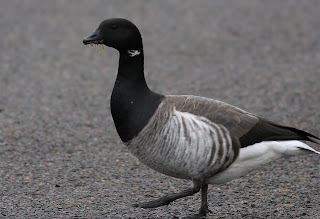


 To my delight I had managed to see both my targets for the day. There was no else to go that we could think of, and the fact that we'd been birding the day before meant that we ended the day at this point and travelled back home. I must say, I went back being a very happy birder after what was retrospectively (especially due to today) a great weekend's birding. I ended the day on 81 species. If you want to find out which birds constitute to this total, please check out this link - http://www.birdforum.net/showthread.php?t=190592 .
ATB,
Joseph
Sunday, 16 January 2011
Delightful Smew At Lochside Pond
Smews... I love them! With a report of a redhead (female) Smew at Lochside Pond at Bridge of Don on the outskirts of Aberdeen yesterday evening, I couldn't resist the temptation of going down to see it this morning. Lochside Pond was only 10-15 minutes drive from the house, so it wasn't long before I was down there. Within seconds of arriving I was on the Smew and had ticked it for the year. This was the second redhead Smew that I had seen within a three week period, with one at Ashford Reservoirs in Somerset on the 31st December. In comparison to the bird at Ashford, this Smew was far more obliging, giving consistently great views at reasonably close proximity, the most distant views of it probably being at about 65ft. There weren't many other ducks on the pond, just a group of Mallards and a few Tufted Ducks, and it seemed to spend quite a lot of its time swimming alongside the Tufties. It was a truly delightful little thing, miniscule yet wonderfully elegant and dainty. Furthermore the light was fantastic, picking out it's beautiful features superbly. The fact that the light was brilliant meant that I spent a majority of my time trying to get photos of it, and I am very pleased with the results. Patience meant that I managed to get within 10-15ft of it, and I seized the opportunity of getting some good shots at this point. Below are some of the shots I took when it was at its closest...

Smew, Lochside Pond, Bridge of Don (16/1/11)


 10-15ft was about as close as I was able to get to the Smew, but this didn't stop me from trying to get some more good photos of it. Below are the best of the other shots that I managed of it. Being able to get photos of such an exquisite species was immensly satisfying, and I felt very privileged to have seen a bird like this so locally. If you want to see bigger versions of these shots, please visit my flickr, which is linked at the bottom of the sidebar on this blog...


 With the Tufted Ducks...

 I was only there for about an hour as I had other plans for the day, so I went home delighted to have caught up with Smew for the year and to have got some good quality photographs of it. Whilst I was at Lochside Pond I also picked up Tufted Duck, Moorhen and Greenfinch for the year, which means the year list is now on 57 species . This, of course, is a petty total, but next weekend I am hoping to reach within the region of 100 species as I will be going out for my first full day's birding of the year then.
Thanks for reading,
Joseph
Wednesday, 12 January 2011
The end of 2010.... the start of 2011
It's been a while since I last posted, The Christmas period is inevitably very busy though, and furthermore I was away without any internet access over the New Year. I have quite a bit to catch up with, so excuse me if this is longer than the last few posts have been!
The end of 2010:
The last time I posted the last bit of proper birding I had done was on the 12th, when I successfully saw the Glaucous Gull at Torry. The 28th saw my Dad and I travelling down to Edinburgh to take a flight to Bristol, and from their to Roadwater in Somerset, a place where my family has a cottage and that I visit several times a year. It was only a few days before the year would come to close, and for a long time I had been desperately wanting to get to 240 before the year was up. I was worried that I couldn't make this total in time, but when I noticed that a Green-winged Teal was around at Kinneil Lagoon in Forth (not very far from Edinburgh) I seized the opportunity of trying to get at least one more bird for the year and headed there on the way down. We arrived at 12:00 with just under an hour to spare before we had to get to Edinburgh Airport to check in. The Lagoon took a while to find, but with the help of a friendly local we were directed onto a small road and found it.
It wasn't exactly the most beautiful of places - a vast, bleak lagoon with the looming backdrop of Grangemouth Oil Refinery pumping out its pollution. There were loads of Teals on the lagoon, with one medium sized group being particularly close in. Unfortunately, this group did not contain a Green-winged Teal. We checked another group that wasn't too far out, but yet again there was no Green-winged Teal amongst them. A scan with the bins revealed a large group of Teals at distance, so the Swarovski was set up, and I proceeded to scan them. There were birds in the water, as well as birds on the waters edge. I thoroughly checked the birds in the water on 60x zoom, but none of them appeared to be Green-winged Teals. Whilst systematically scanning the mostly roosting birds on the water's edge, I thought I saw a Teal stretching with a vertical white stripe on the side of its breast. For a second I disregarded it and thought I was maybe just seeing things, but I couldnt help but retain interest in the bird. It was with 2 roosting Teals, and because it was roosting itself and nestled behind one them I couldn't anything apart from the back of its head. I kept on looking at it though, purely based on thinking that I had seen that one flash of a vertical stripe. I waited for it to move, but after several minutes of conferring with my Dad none of the birds had moved. Suddenly, after about 10 minutes, the roosting bird in front moved, to reveal a Teal with a vertical white stripe down its back - I had found the Green-winged Teal. I was delighted and proud of myself for having stuck on that bird, as I could have so easily just have disregarded it and never have found it. I was now getting views of roosting Green-winged Teal, my second sighting of this species ever, and they weren't at all bad views on 60x zoom. Whilst I watched it, I also noted other diagnostic feature such as the lack of the white scapular stripe which would be present on an ordinary Teal and a smaller patch of yellow towards the tail in comparison to other Teals. Of course, I would have much preferred views of the bird actually do something rather than roosting, and a majority of my views were of it roosting unfortunately. Only once did I get non-roosting views of it, when it woke up at one point and had a little waddle along the waters edge before going back to roost with another group of Teal. We left it at that, and I was very happy with having successfully twitched this bird - I had not expected I'd get one for the year!
239 wasn't enough for me though, and nor was just a twitch to see a Green-winged Teal; I needed to have a full's days birding before the year was up. My Dad and I agreed that we'd have a final birding day of the year in Somerset on New Year's Eve (31st). I managed to get Wi-Fi on the evening before this, and I checked birdguides to see if there was anything around in Somerset that I hadn't seen for the year. As I did so, I came across a report of a redhead Smew at Ashford Resrevoir, and when I read the details of this bird I also discovered 2 Green Sandpipers had been seen there. This came as quite a shock, as not only was it probably the commonest bird that I hadn't seen for the year, but it seemed like completely the wrong time of year for any of them to be around! I looked further into this sighting by going on the Somerset Birding website, and in doing so I discovered that several Green Sandpipers had been seen around Somerset that week, not just at Ashford Reservoir (see here: http://pub13.bravenet.com/forum/static/show.php?usernum=1065729998&frmid=14&cmd=show&cp=3) ! This meant that Ashford Reservoir would be our first port of call the next morning, after finding out that it was in an area that was en route to where we wanted to spend most of the day.
At 11:30 the next morning we arrived to find it partially frozen. It was very small - you could walk from one end to the next and back within a couple of minutes. Unfortunately the public can only walk on the periphery of the reservoir, and futhermore only on one side of the periphery, the rest of it is inaccessible to those without permission. This didn't make viewing through the optics difficult, but meant that I wasn't able to get any photos as the birds were too far away for that. We immediately came across a large raft of winter wildfowl, which included several different species of duck. Amongst the most common species (Wigeon, Mallard, Teal) I counted 6 Gadwalls, 2 Shoveler (drake and female) and 2 drake Pochards. There was also a maximum of 10 Little Grebes present, really astonishing considering the size of the reservoir, and a single Little Egret. Of course, the highlight was the redhead Smew. This was a lovely little duck (my second of the year), a midget amongst a whole array of comparatively huge duck species. It spent quite a lot of its time diving, and I lost it a few times due to the amount of ducks that it was swimming amongst. However, views were absolutely stunning through the Swarovski when it wasn't diving, the closest it came being about 65ft.
We watched it on and off during our stay, but were primarily looking for Green Sandpipers. After a meticulous check of the actual Reservoir, it seemed there were none around, until suddenly we heard a call, the diagnostic, trisyllabic whistling notes of a Green Sand. It did this a few times, then stopped. We headed back towards the front of the reservoir, and as we waited it started again, far louder this time. We both looked round to see 1 Green Sandpiper shooting across the reservoir, its white rump flashing vividly and completely revealing its identity, calling as it went. Instead of landing, it flew at speed away from the Reservoir and quickly out of sight. It felt pretty strange; on the 31st December I had seen a Green Sand - a year tick that I was almost sure had eluded me, and at more or less the wrong time of year to see one! It must have been the hard weather conditions that had brought this bird in. I was elated, as I had made 240 species for the year, and I left Ashford Reservoir feeling that it was well worth the visit, especially with the addition of the Smew!
The rest of the day was much more laid back. We spent it at Shapwick Heath, a vast area of marshland adjacent to the very similar Ham Wall RSPB. Both of them together are arguably the best places to go birdwatching in Somerset. We had no particular aims, and were just curious to know what had been around, although I was aware a Great Grey Shrike had been seen here. We headed towards the main hide (Noah's Hide), and on the way spotted a large flock of finches in the woodland areas nearby. This proved to be rather entertaining, as we managed to count a total of 50 Siskins and 20 Lesser Redpolls - with good views obtained of both species as they filled the woodlands with their cacophonous calls. There were also plenty of tit species around, most notably 25 Long-tailed Tits that I attempted to photograph - I quickly discovered that they were just that bit too mobile for any decent shots! Furthermore, there was also a stunning male Bullfinch and a Treecreeper here. As we approached the hide, we warned not to go in there as someone had... put it this way... defecated inside it! As you can imagine, that immediately put us off going in there, so we had to find an alternative way of viewing the lake. We luckily managed to find a clearing in the reeds and thus were able to view a majority of the lake. Most of the ducks on the lake were Tufted Ducks and Wigeons, but there was a few Teals amongst them as well, and a female Goldeneye. I was very pleasantly surprised however, when I found 3 Bewick's Swans amongst a group of Mute Swans. Bewick's Swan was a species that in March 2010 had been a major bogey bird for me, until I finally managed to see one at the Ythan Estuary. The sighting of these 3 meant that this was my first ever of any proper amount of Bewick's Swans in a place where they actually winter! It was lovely to watch these birds, clearly much smaller than the Mutes, all swimming with one another. I watched them for about 10 minutes, and then we decided we'd have a go for the Great Grey Shrike that had been around, having been told that it was around by a birder who had just seen it. What a way to round off the year this would have been, but despite walking and checking the exact area of alders that the man said he had seen it in, we couldn't find it. The sun was starting to set, and we had other dedications for the rest of the day, so we went away very happy with our day in the end. It had been an absolutely sensational year, with the initial target for the year (200), as a result of that day, having been beaten by a total of 40 species - the year thus came to a close, and I ended it on 240 species.
The Start of 2011:
Unfortunately the new year has seen very little birding so far due to me being busy. I've decided that this year I will be holding two different year lists - one for the whole of the UK, and the other just for Scotland. The latter my Dad and I will do, whilst the UK list will be for online purposes. Due to the lack of birding so far, the yearlist isn't at all high. However, some useful birds for the year have been seen already. The fact that I was at the cottage in the heart of the Somerset countryside during the New Year meant that I saw quite a few birds that might otherwise take a while to see. The first species I saw for the year was certainly unusual - two Ravens from the cottage window (I opened it so I could their coarse croaking). A pleasant walk around the area on New Year's Day saw me catching up with some of the usual suspects - the common Pigeons, Crows, Finches (including Siskin), Tits, Buzzard and the seemingly abundant Pheasants of the area. Amongst this expected lot though were some slightly more interesting birds. Early on the walk, the diagnostic call of a Great-spotted Woodpecker was heard, and I looked up one to see one flying in the archetypal undulating fashion that these woodpeckers do. Not long afterwards I was glad to flush 2 Jays from some trees, a species that normally takes me a while to get in Aberdeenshire. These weren't the only other welcome surprises, as the local river has a resident Dipper that I managed to see towards the end of the walk, a Grey Heron was sighted (only my second I have ever seen in the area), I chanced upon a possy of 15 Long-tailed Tits, and the main highlight, a Nuthatch. Nuthatches are non-existent in North-East Scotland, so it is always a delight to see them when I'm down in England as I don't ever see them when I'm at home (the first record of Nuthatch for NE Scotland happened to be last year). This particular bird was quite high up in a tree, so I didn't get the best views, but I am very glad that I have caught up with this lovely species so early in the year.
On the 3rd I caught up with a few more species when visiting my grandparents in Minehead including Herring and Black-headed Gull (much later than usual!), Dunnock, Wren, Robin, Redwing and Fieldfare. None of these are exactly notable at all, but a male Blackcap on my grandparents' feeders certainly was, seen briefly as I attempted to pick up some of the commoner garden birds for the year. This is the earliest I have ever seen Blackcap in a year - in Aberdeenshire it normally takes until April before I'm able to catch up with one! An even more surprising year-tick for the time was a Tawny Owl that flew across the road when we were on the way back from seeing my grandparents - there is quite a healthy population of this species in the area. It was looking like quite a reasonable start considering that I hadn't been birdwatching, with Nuthatch, Tawny Owl, Jay, GS Woodpecker, Long-tailed Tit, Blackcap Raven and Dipper having already been seen.
I finally got out to do some birding this Saturday just gone (8th), but unfortunately I could only manage a couple of hours because I had other dedications later on the day. These two hours were mainly spent checking Girdleness, but I thought I'd try and start the year on a good note by trying to pick up the wintering Glaucous Gull in the industrial areas of the nearby Torry. Almost as soon as we arrived I sighted it on top of its favoured warehouse - a big, white warehouse marked 'ASCO'. It took me 12 months to see one in 2010, so to have secured the species on the yearlist at this stage was a delight and I am sure will prove valuable. Just as it was before, it was staying around two streets called Crombie and Sinclair Road, particularly favouring the latter this time. I managed to get quite a few more shots of the bird; unfortunately, though, I wasn't able to get as close as last time, and it stayed much higher up. Below are some images of it (light wasn't great, so pictures aren't brilliant):

Glaucous Gull, Torry, Aberdeen (8/1/11)


Showing off that all white appearance...

After spending some looking at this fine creature, we headed to Girdleness and thus managed to pick up the common birds of the area - Eider, Great Black-backed Gull, Cormorant and Shag, Oystercatcher, Turnstone, Common Gull, Guillemot and so forth... Most notable of all year ticks here, although pretty easy and a resident of the area, were 20 Purple Sandpipers from Greyhope Bay. There wasn't much time before I had to get back home, but I was still keen to pick up on some freshwater species, so I decided it was best to head to the nearby Loriston Loch. Here, species such as Kestrel, Mallard, Mute Swan, Wigeon and Rook were seen and added to the year list. That was all I had time for though, so I am currently on 53 species for the year... As I said, not overly impressive, but bare in mind I'm still yet to have a full birding day! When I do next have a full day's birding, I will make sure I post about it in here!
Thanks for reading,
Joseph
Wednesday, 5 January 2011
NEWS: Yearly Birding Review For 2010 Page Now Published!
YEARLY BIRDING REVIEW FOR 2010 PAGE NOW PUBLISHED
Whenever a new 'page' is put up on my blog, there will always be a blog post that alerts you that it has been put up. Pages are other parts of your blog in which you can add text, photos etc., away from the main part of your blog. All my pages are situated as tabs below the title picture of my blog.
This post is alerting you that I have now completed my Yearly Birding Review for 2010, a year that was truly sensational for me. It is situated in a tab below my title picture named 'Yearly Review (2010)'. I would really appreciate it if you gave it a read and commented on it in here! Thanks very much!
I still need to post about the end of 2010, so expect a post on that in the next few days! I haven't been birding this year yet, but I am aiming to get out this weekend, so you can expect another post around then. Also, I am hoping to complete my Fair Isle trip report soon, so its going to be quite a busy next few weeks on the blog!
In the mean time a Happy New Year to you all and best wishes for 2011,
Joseph
Whenever a new 'page' is put up on my blog, there will always be a blog post that alerts you that it has been put up. Pages are other parts of your blog in which you can add text, photos etc., away from the main part of your blog. All my pages are situated as tabs below the title picture of my blog.
This post is alerting you that I have now completed my Yearly Birding Review for 2010, a year that was truly sensational for me. It is situated in a tab below my title picture named 'Yearly Review (2010)'. I would really appreciate it if you gave it a read and commented on it in here! Thanks very much!
I still need to post about the end of 2010, so expect a post on that in the next few days! I haven't been birding this year yet, but I am aiming to get out this weekend, so you can expect another post around then. Also, I am hoping to complete my Fair Isle trip report soon, so its going to be quite a busy next few weeks on the blog!
In the mean time a Happy New Year to you all and best wishes for 2011,
Joseph
Subscribe to:
Posts (Atom)